
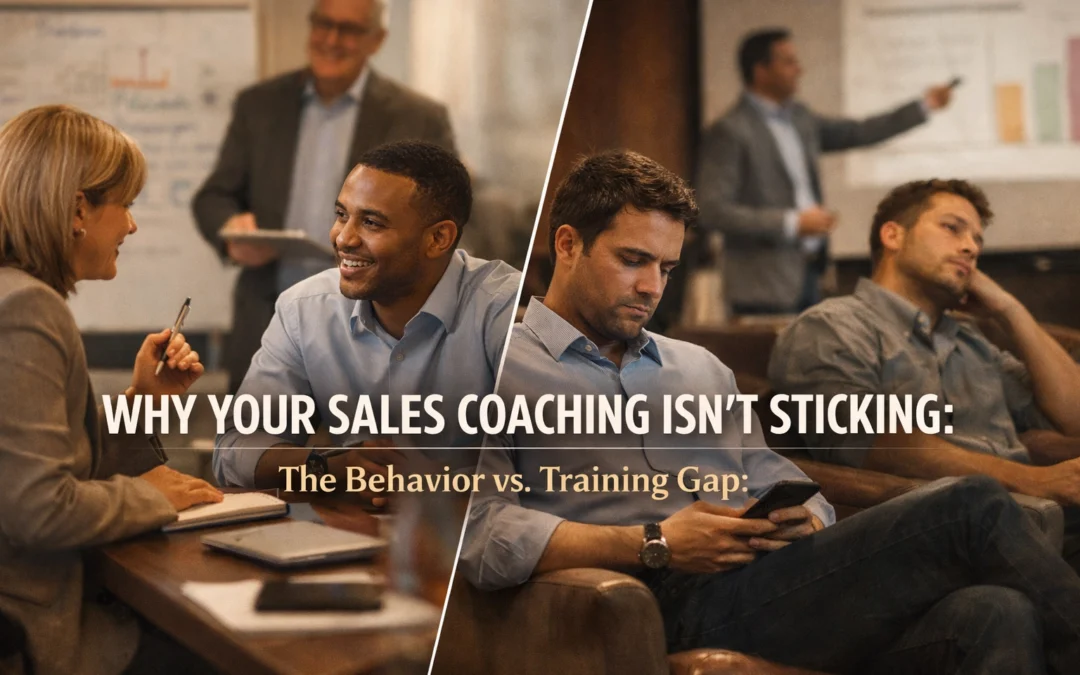
You’ve invested in sales coaching. Or at least, you thought you did.
Maybe it was that three-day workshop with the slick facilitator. Maybe you brought in a “sales guru” who promised to transform your discovery process. Your reps nodded enthusiastically, took notes, and walked out energized.
Two months later? They’re back to their old habits—because your “investment” was mostly a morale event with a workbook.
And here’s the part founders hate hearing: this isn’t just “annoying.” It’s expensive. It’s leaking margin. It’s stretching Time to Quota. It’s burning cash while your pipeline looks full.
If this sounds familiar, you’re not alone—and you’re not crazy. The problem isn’t that your team is unteachable or that the training was worthless. The problem is that training is not behavioral change, and most companies keep paying for information when what they need is new defaults under pressure.
The Coaching Spend That Quietly Bleeds Your Business
Here’s the uncomfortable truth: only 21% of sellers report that their coaching is actually effective. Let that sink in. Nearly four out of five sales professionals say the “coaching” they receive ranges from mediocre to utterly useless.
And founders usually respond with: “So… we need better training.”
Sorry to say—that is poor advice.
Research shows that people forget up to 90% of new information within a month without reinforcement. Your team isn’t lazy; their brains are doing exactly what human brains evolved to do: filter out information that doesn’t get reinforced in real-world application.
Most sales training is treated as an event, not a behavior change system. You send your team to a workshop, they learn a new discovery framework or objection-handling technique, and then… nothing. There’s no reinforcement in the CRM where they actually work. No manager reviewing call recordings against the new standard. No accountability structure that bridges the gap between “I understand this in theory” and “I can execute this when the prospect is skeptical, I’m behind quota, and my confidence is wobbling.”
You see, knowledge transfer doesn’t automatically translate to behavior change. Your reps can explain SPIN perfectly while still defaulting to feature-dumping the moment a prospect asks a tough question.
And while that’s happening, three founder pains show up—fast:
- The Referral Trap: your reps can’t create pipeline from colder markets, so you drift back to “who do we know?” as a strategy.
- The Founder Bottleneck: deals “need you” to get unstuck, because nobody else can run a clean, trust-based sales conversation.
- Valuation Penalties: investors don’t pay premiums for revenue that depends on your personality, your network, or heroic end-of-quarter rescues.
The Behavior vs. Training Gap (A.K.A. Why You Keep Paying Twice)
Before we can solve this problem, we must first define it. Here’s the fundamental, semantic distinction: skills are not behaviors.
Training teaches skills—the “what” and the “how.” Behavioral change work addresses the “why” and the “when.” More importantly, it creates the accountability loop that turns knowledge into repeatable execution.
Think about it this way. If I send you to a workshop on active listening, you’ll learn techniques: paraphrasing, asking follow-up questions, managing your own cognitive biases. That’s the skill.
But the behavior is whether you actually pause before jumping to solutions when a prospect reveals a pain point. The behavior is whether you resist the urge to pitch when you’re feeling quota pressure and the quarter is closing. The behavior is whether your rep keeps control of the process when the buyer says, “Just send me pricing.”
And here’s the money part: surface-level coaching (or “drive-by feedback”) is how companies pay twice—once for the workshop, and again in discounts, stalled deals, and founder time spent rescuing opportunities.
Behavioral coaching addresses the underlying patterns that cause your team to revert under stress. It’s not about memorizing a script; it’s about rewiring the instinctive responses that kick in when things get messy. And that requires more than a PowerPoint and a role-play session.
The Missing Ingredients (And Why “More Training” Is Usually a Waste of Cash)
So why does most coaching fail to stick? Three critical gaps:
1. Coaching is sporadic, not systematic
Fifty-three percent of sellers receive coaching quarterly or less. Thirty-seven percent rarely or never receive personalized feedback.
You can’t change behavior with quarterly check-ins any more than you can build muscle with one workout per season. And if you’re the founder reading this, here’s the kicker: when coaching is sporadic, you become the system.
That’s the Founder Bottleneck in a suit.
Behavior change requires consistent reinforcement: daily and weekly touchpoints that keep new habits front-of-mind during actual sales situations—live deals, real objections, real pressure.
2. Managers aren’t equipped to drive behavioral change
Most sales managers were promoted because they were great individual contributors—not because they know how to diagnose behavioral patterns or deliver feedback that actually changes what happens on the next call.
So they default to outcome coaching (“close more deals”) instead of behavior coaching (“let’s listen to three discovery calls and pinpoint where you start pitching early because silence makes you nervous”). Without frameworks and tools, even well-intentioned managers end up delivering generic pep talks instead of targeted behavioral interventions.
And when managers can’t coach behavior, founders typically step in. Again. Welcome back to the bottleneck.
3. Training and execution environments are disconnected
Training happens in a conference room with hypothetical scenarios. Execution happens in Zoom calls, CRM notes, and high-stakes negotiations where the stakes are real and the pressure is on.
If your behavior change work doesn’t happen inside the tools and workflows where your team actually sells, you’re asking reps to bridge that gap on their own—and they won’t. They’ll default to what feels safe: talk more, pitch sooner, discount earlier, chase “maybes.”
That’s how you end up in the Referral Trap: “We’re great when deals come warm… but cold outbound feels like pushing a boulder uphill.” No kidding. Warm intros cover for sloppy behavior. Cold markets punish it.
What Actually Works (Behavioral Change, Not “More Coaching”)
Effective behavioral change work isn’t complicated, but it does require a shift in how you approach development:
Focus on behaviors, not outcomes
Instead of “you need to close more deals,” try: “I noticed you’re presenting solutions before you’ve confirmed the economic buyer is in the room—let’s fix your qualification behavior.” Behavioral change is specific, observable, and tied to actions the rep can control.
This is where money stops leaking: fewer zombie deals, fewer fake next steps, fewer “send me a proposal” punts that go nowhere.
Make behavior change continuous, not episodic
This means integrating reinforcement into daily workflows. Manager one-on-ones that review recorded calls against a shared rubric. Peer sessions where reps dissect real opportunities. Micro-learning delivered in the CRM at the moment of need.
The goal is to shrink the gap between learning and doing until they’re essentially the same thing—because that’s how you stop needing the founder to “jump on” every serious call.
Equip managers with frameworks, not just expectations
Your managers need observable checklists that define what “good” looks like for each stage of your sales process. They need coaching templates tied to your methodology. They need behavioral tools: how to identify patterns, interrupt them, and reinforce new ones without demoralizing the rep.
Make behavior change leadership a skill your managers develop—not a box they check on a performance review.
Tie behavioral change to metrics that matter
Behavioral change isn’t soft and squishy; it directly impacts business outcomes. When done right, it reduces Time to Quota (new hires ramp faster because they’re building correct habits from day one) and improves Retention (reps who are getting better actually stick around).
It also protects valuation. If revenue requires founder heroics, investors see risk. Risk equals a haircut. That’s the Valuation Penalty—and it’s avoidable.
The Real Work Begins After the Workshop (That’s Why Most “Coaching” Fails)
Here’s the provocative part: if you’re frustrated that your sales training “didn’t work,” the training probably worked fine.
What didn’t work was everything that happened—or didn’t happen—after the workshop ended.
Training gives your team new tools. Behavioral change systems ensure they actually use them when it counts. Training is the blueprint; behavior change is the construction process. You wouldn’t hand a blueprint to an apprentice carpenter and expect them to build a house unsupervised—so why do we do exactly that with sales?
And candidly, “surface-level coaching” is often just expensive commentary. It makes leaders feel helpful without changing the rep’s default behavior on Monday morning. If that stings, good. That sting is your margin talking.
The Tonkin Group’s approach starts with a simple premise: sustainable performance improvement requires aligning behavior with strategy—not just transferring knowledge. That means working with founders to build behavior change systems (accountability, reinforcement, observable standards) so you can:
- escape the Referral Trap
- remove the Founder Bottleneck
- avoid Valuation Penalties tied to fragile, personality-driven revenue
If your sales team is underperforming despite training investments, the gap isn’t their potential. It’s the space between what they learned in a workshop and what they’re held accountable to execute in the field.
Close that gap, and you’ll stop wondering why your coaching doesn’t stick.
Because finally, it will.